
What Poets Do
Am I doing this right? Probably not.

I ask myself this question a lot: What is poetry? What separates it from prose? Is it meter? Sometimes. Rhyme? Not that often really. Form? Occasionally. Subject? Not so much.
Maybe poetry’s like pornography: You can’t define it but you know it when you see it. Or read it. Or hear it. Or all-of-the-above it.
Hey, that was kinda poetic!
I wrote poetry when I was a kid. The first time I submitted my writing for publication, it was a poem to Seventeen about my cat when I was 11.
That was also my first rejection letter.
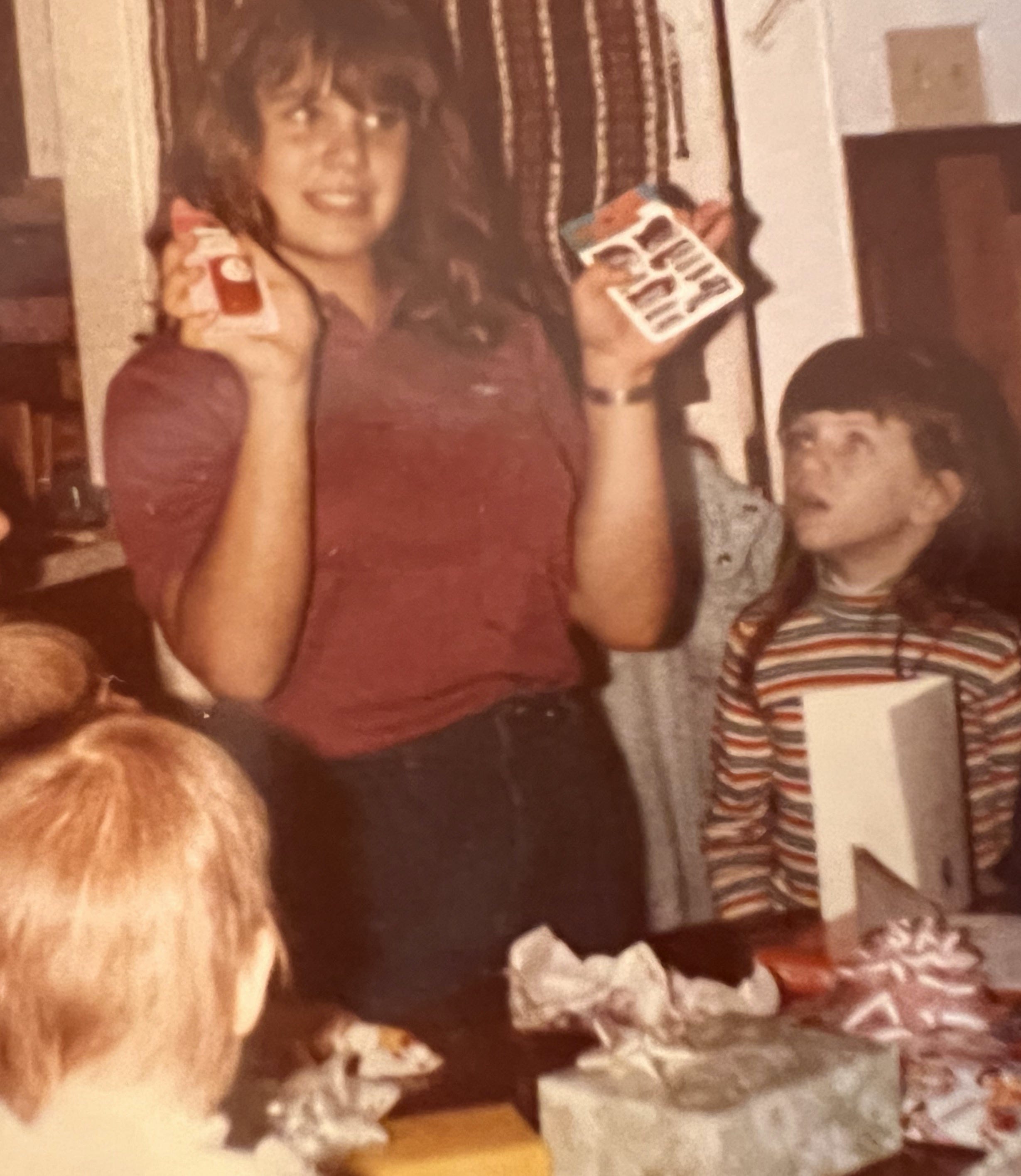
A few years ago a high school friend scanned and posted the literary journal from our sophomore year on Facebook.
If you’re an artist of any sort and you regret losing your youthful creations, this is how you get over it.
I might not have looked goth back then, but judging from the number of dead babies and cemeteries in my poetry from that era, I am goth down to my rotting bones.
I remember writing a poem in 1996 during a fit of insomnia. Or as I called it then, “every fucking night.” I was watching MTV and saw the video for “Closer” by Nine Inch Nails for the first time. That closet goth girl was moved to poetry by the occasion. I do wish I had a copy of that one, because I remember part of one line that was pretty good.
And that, I thought, was the end of poetry for me, mostly because I didn’t really understand it despite devouring the materials in my college poetry classes. Writing lines to describe a scene or a feeling seemed easy to me when I did it, compared to maintaining the momentum of an essay or story. Obviously the poets know something I don’t, and I’m not doing it right.
I still believe that.
And yet, since 2018, I’ve had my work chosen to be included in the annual Woody Guthrie Poets readings every year that I’ve submitted.
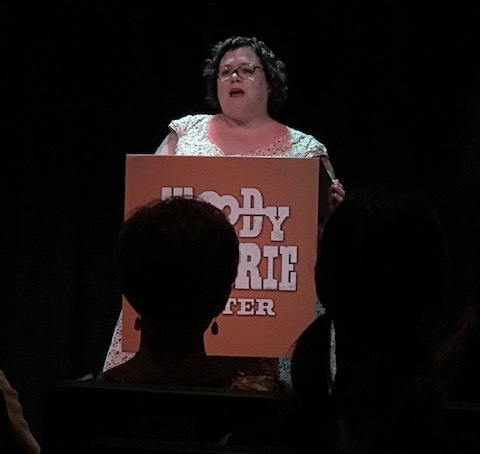
At this point I assume I’ve been grandmothered in or something.
I learned about Woody Guthrie Poets through a post on Facebook, and was drawn to the concept: Every year a Woody lyric is chosen, and poets work from that thematic angle, then submit their work. The selected poets get divided into three readings in Oklahoma City, Okemah (Woody’s hometown), and Tulsa on the weekend closest to Woody’s July 14 birthday as part of Woodyfest.
Considering that, for nearly 15 years, I’ve used around 85 percent of my brain in figuring out how Woody’s old words so beautifully fit into modern life, it seemed like a good use of my skills that first year. A fun writing challenge that probably wouldn’t go anywhere.
I love being wrong.
Woody Poets has become one of my two favorite weekends every year, competing only with my spa weekends in Kansas with CJ. Writing the poems each year remains a writing challenge (I still think my poems are just prose with different line breaks), and each year I meet and get to know more and more of the poets who make me wonder who the hell said I could hang out with the cool kids.
(The structure of that sentence indicates I’m probably not really a writer of any sort.)
Last year I attempted to attend all three Woody Poets readings, and was two-thirds successful. What kept it from being 100 percent successful? A fucking migraine. This year, I dragged out that drive to Oklahoma City so I wouldn’t have a repeat, and it worked.
After taking it easy in my hotel and writing on Friday, instead of battling the Oklahoma City heat, I made my way to Rodeo Cinema in the city’s Stockyard City neighborhood. I expected the type of gentrified neighborhood that so many art house theaters made from old movie theaters are in.
I was wrong. Mostly.
Stockyards City is just that—a business district that borders the city’s enormous cattle trade stockyards. It’s what the “Old West” would maybe be if the U.S. hadn’t become so homogenized through telecommunications and expanded travel opportunities. Decades-old steakhouses sit beside boutiques which sit beside western wear stores that sell cowboy boots to people who actually need them for work.
Had it not been so hot, and if I’d allowed more time, I would have loved to have walked the neighborhood. Maybe in less migrainey future times.
The air conditioner struggled at Rodeo Cinema, but who could blame it in heat not meant for man nor machine?
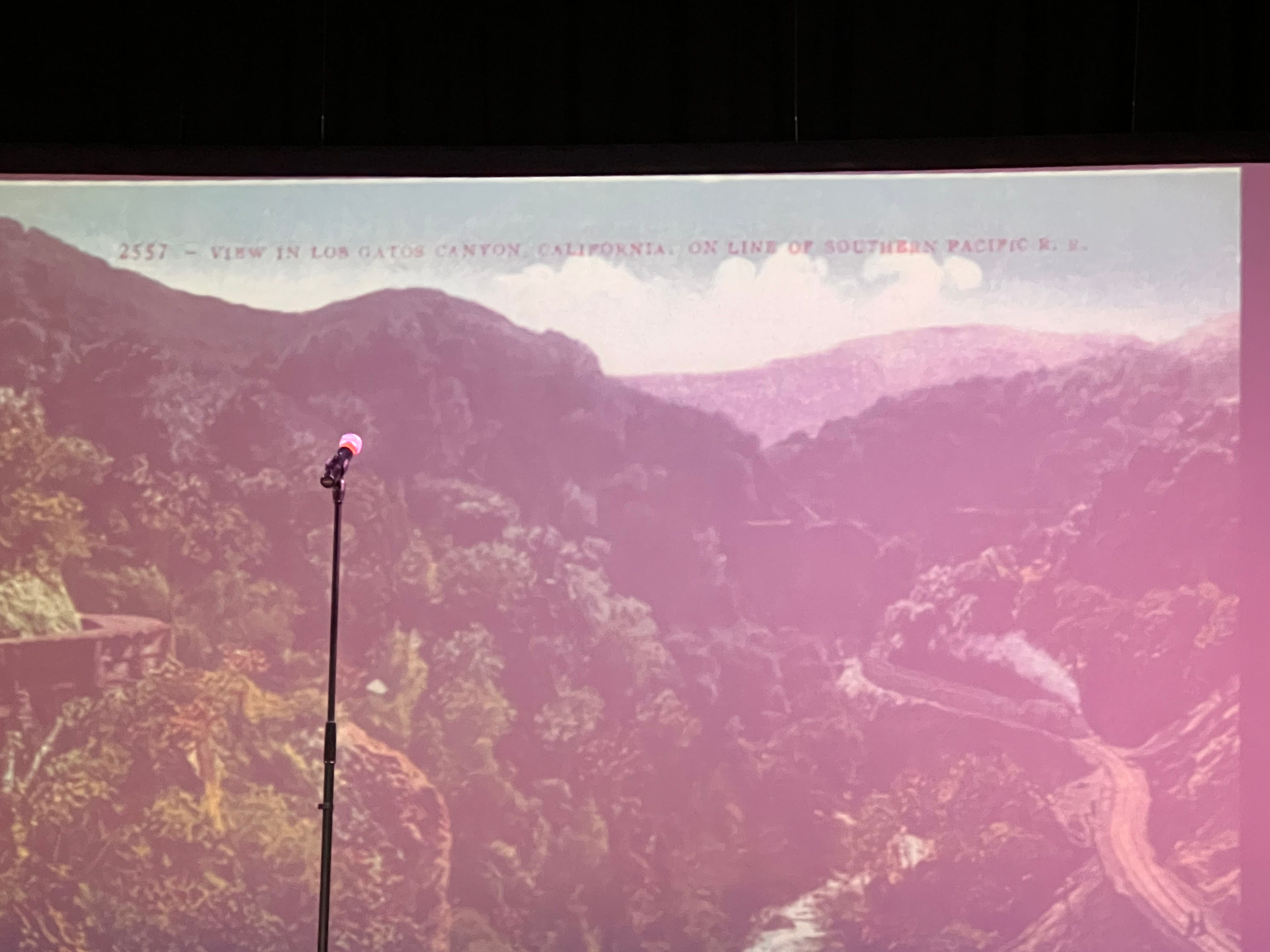
This year’s Woody Poets lyric was particularly timely. Although this is the beauty of Woody: his lyrics are damn near all particularly timely, no matter the time. Part of it was his ability to capture universal emotions and experiences in a way that shatters man-made walls. The other part is because we’re so bullheaded about changing what needs to be changed that we keep fighting the same wars over and over, just with bigger guns.
This year’s lyric: “All they will call you will be deportee.”
If you don’t know the song … why are you here? Do you know me? Because I talk about this a lot. Quick version: Almost 80 years ago there was a plane crash that killed everyone on board, the vast majority being legal Mexican workers being shipped back from where they came because farm bosses no longer needed their labor. News coverage only gave names to the white people who died in the crash. Woody got mad and wrote lyrics. My friend Tim Z. Hernandez tells it way better than I do.
Living in the time of ICE makes these words an ever-present thought for some of us. It’s a melody that haunts me with every new name added to the roster of people who shouldn’t be dead but are. It was a list read by Woody Poets curator Ky George to begin the night’s readings.
I was in tears by the second poem. The poet, Holly Zorn, read her poem about the day her son got in the car after school, sad because one of his friends was gone.
And I was gutted, her words bringing back the despair and anger I felt the day in 2014 when I sat 10-year-old CJ down and told them what they should do if they encountered police while playing with their Black friends.
Is that what poetry does? Because all weekend, that’s what poetry did to me.
(Cassie Premo Steele shared the poems she read in Oklahoma City on her Substack. This? Definitely poetry.)
I didn’t hang around long after the readings, needing some time with my thoughts and emotions, and to prepare to do it again the next morning in Okemah.
The Okemah reading takes place at the Okfuskee County Historical Society, on Woody’s front porch. I was more social this time, thanks to the always-close quarters in the historical society. A good night’s sleep helped, too.
Remember when I briefly did a podcast here? My friend Paul Juhasz was such a good podcast guest last year, talking about his annual silent treks into the mountains that I didn’t think anyone could top it so I quit. (You can listen to it. I took the paywall down.) Also? He was recently nominated for a National Book Award, so there’s no arguing that he’s a poet. A really fucking good one. Should I believe him when he tells me I’m a poet? Maybe.
What’s funny is, every time I heard people congratulate Paul on his nomination, he sounded like I do when people tell me I’m a poet. Nah, not me. Someone made a mistake.
Maybe poetry has something to do with imposter syndrome? I don’t know. We’ve established that I’m a hack, right?
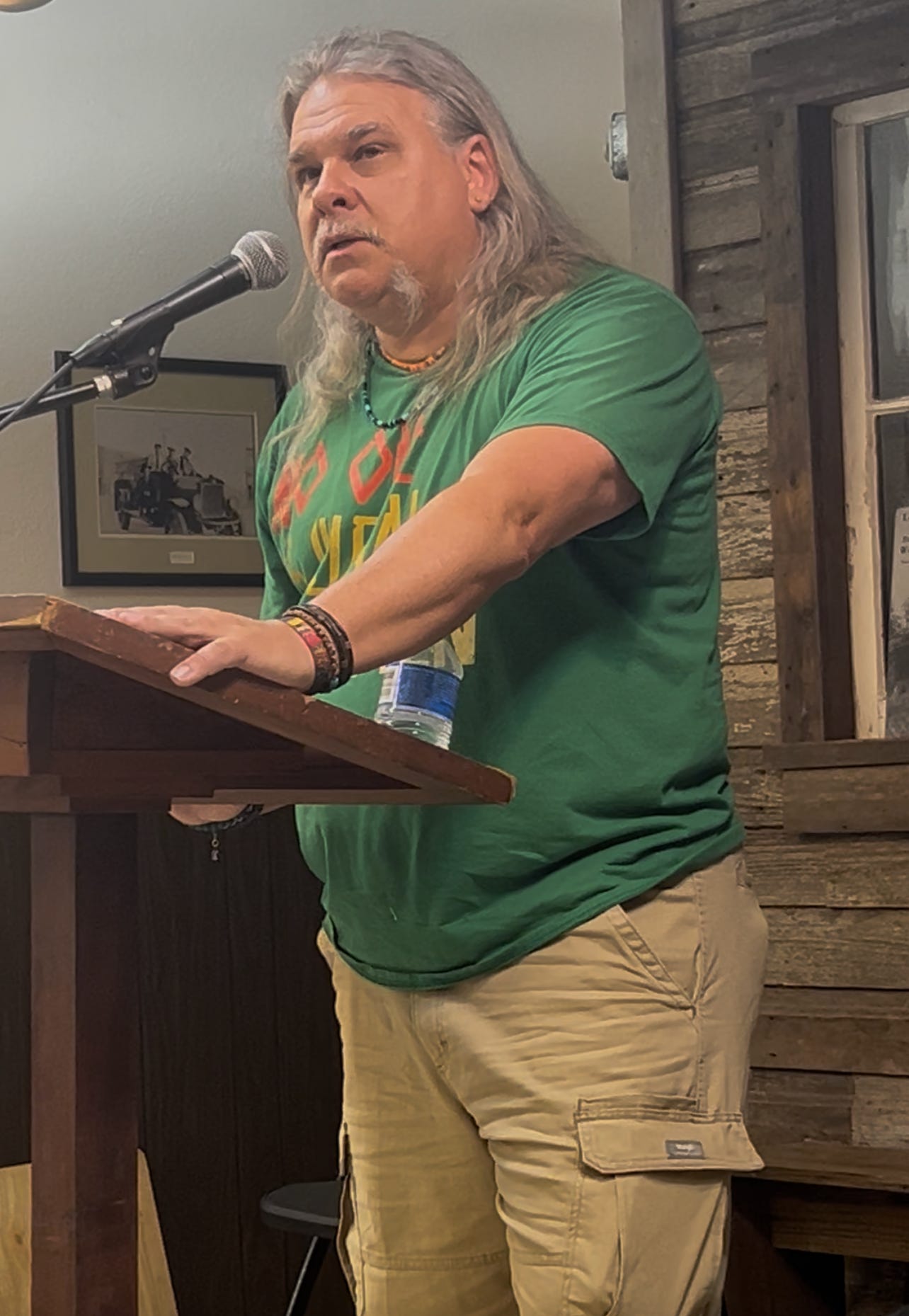
Am I purposefully only writing about the first poet at each reading? No. I wish I could write about each person who read their work, because there wasn’t a single piece that didn’t provoke my thoughts, stir my emotions, and make me understand what is happening now, what happened in 1948, like these magnified bits of minutia we call poems.
Is that what a poem really is?
On Sunday, I was in the middle of the list of readers taking the stage at the Woody Guthrie Center. My home. The stage where they put me every year, which shares a wall with the archives where I spent four weeks surrounded with the minutia of Woody’s life. Letters scribbled on hotel stationary in pencil—that degree of minutia, holding the truths of life that are likely to wind up at the bottom of the trash can. Because that’s where the truth too often comes to rest.
As at the previous two readings, Ky opened with a reading of the names of the twenty people killed by ICE in 2026. This stark, unadorned list wasn’t labeled “poem,” but I think it counts in how it tells the truth, provokes thought, and swells feeling.
Less than 24 hours later, there would be another name on the list. Johan Sebastián Durán Guerrero.
In scouring the internet for information about the ICE-related deaths immediately following Woody Poets weekend, details are questionable and sketchy. Look up Kilmar Abrego Garcia, and the first hit is a DHS page with the headline calling him an M-13 gang banger based solely on a long-ago local police investigation that never merited an arrest.
Who do we believe?
I believe what Paul wrote about Garcia.
Is that what poets do?
Despite not feeling like I’ve earned the title, this year I took to the poet’s stage faking a sense of confidence that I usually can’t muster. For once I made a point of focusing on the words I had written, instead of making sure I read them fast enough to fit the time limit but not in my usual Gilmore Girls pace that’s hard for people without ADHD to understand.
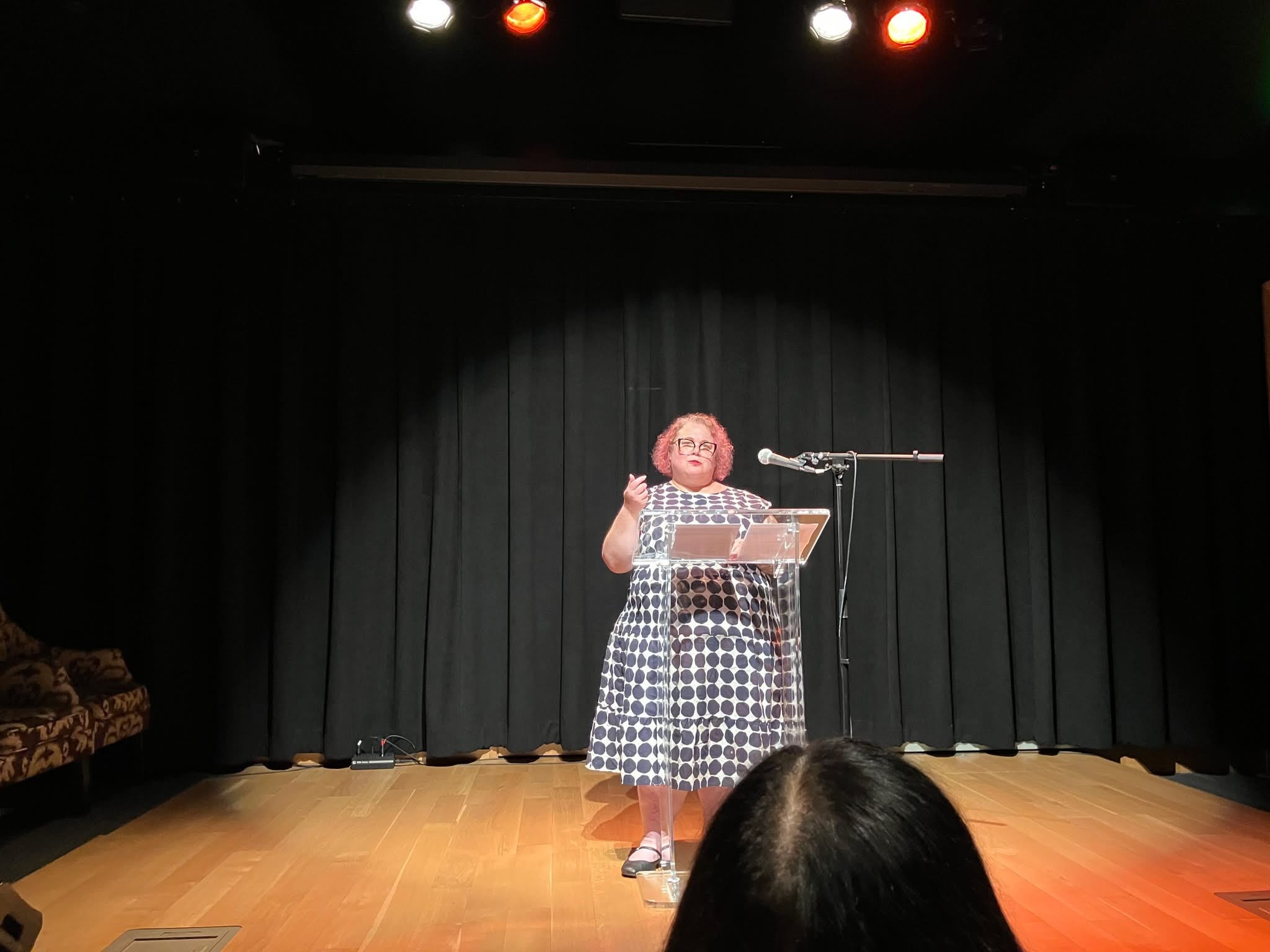
While feeling like an imposter is generally a lonely place, I don’t think I was quite as alone in that feeling at the Tulsa reading as I usually am. When we were gathering in the lobby before start time, the buzz of everyone suddenly quieted, replaced by whispers. My friend Durell Carter, (Who is absolutely a poet, declaring, “I am not your favorite son” when he started his reading. It was a line that shot through the toughened white skin of my chest, directly into the beating of my heart.) whispered, “Joy Harjo is behind me.”
Oh! A former United States Poet Laureate is here to watch us read? That’s why so many of us look like we’re about to burst into tears! Got it.
I’m not prone to getting star-struck, but Harjo is one of the people who does it to me. In fact, my most embarrassing moment with a person of renowned involved her. A few years ago I was stepping out of the Bob Dylan Center and almost ran into her. She lives in the neighborhood, and was walking at a brisk pace, a giant old potato chip can under her arm. And I saw fit to look her in the eye and say, (I cannot believe I’m going to repeat this.)
“Oh hey! It’s you, Miss Poet Laureate!”
Woody, I know you like to blow up transformers in this neighborhood so if you could explode the one closest to me and remove me from this mortal coil, now would be the perfect time. Thanks!
When I did my reading, my brain was busy thinking about the poems I had heard, and the words on the printed pages before me, with my words and thoughts, so I wasn’t thinking about the fact that I was reading my non-poems with Joy Harjo in the audience. It helped that the stage lights were bright and I couldn’t see past the fourth row. I convinced myself she had left before we started, and just happened to drop in on some official business before the reading, since she’s the artist-in-residence at the Bob Dylan Center.
Nope, she was there, I was assured after the fact, when it was too late to throw up on the podium.
I can tell you what poets did after the reading. They convened down the street at The Tavern, took up three big tables, drank a lot of bacon old fashioneds (the migraines forced me to abstain so surely that revokes my poet cred), ate a lot of deviled eggs, told a lot of tales, sweated in the Oklahoma July afternoon that the best air conditioners can’t fight, and, at least for this one, felt at home with people who raised their glasses when I toasted, “To words!”
And that, friends, is what poets do.
(The Pickup sent a poet to review the Tulsa reading, and she tells it better and with less self-flagelating than I did. And hey! They also published a piece I wrote about the next generation of Woody followers, so continue your reading over there.)
I loved all of this!